


Quote:
Originally Posted by Jeff Hendrix
I just got back from a 1-on-1 session at Old School CrossFit in Montgomery to look at my squat form. He was a great and friendly trainer and I'm really glad I went to see him. I practiced the LBBS with the trainer and found out that I was going to deep and, hence, not really involving my glutes and hamstrings like I should be. I was also collapsing my chest, which I already knew about.
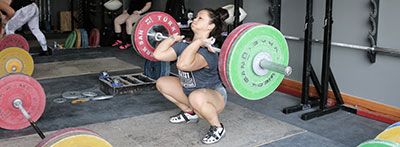
At any rate, I wanted him to go over the HBBS and FS with me. He kind of just told me to ignore the HBBS (I wasn't too surprised with this, so no huge loss) because of my height. Regarding the front squat, it seemed as if he were telling me that I still need to push my hips back as I am going down--I got that he was saying it is essentially the same as the [low bar] squat, except that the bar is in a different place, but somehow I'm still supposed to push my hips back and keep my chest upright. I was under the impression that you're supposed to shove your knees forward in an effort to keep your hips over your feet. Were we just communicating poorly, or is someone way off base here? Or maybe he thinks that I need to make this accommodation due to my height? I figure he knows what he's talking about, so I guess I need clarification on what he was trying to communicate to me.
If you push your hips back any, aren't you going to have to deal with your torso leaning forward and the bar tending to come off of your shoulders?
|
almost none of that makes sense. post a vid if you can, many people here know how to front squat and can give you some good cues I'll bet. not to say he's wrong...just that all the cues you're describing are different from what i'd expect.
(lbbs and hbbs are political terms and have very little to do with squatting and everything to do with OL vs. Pl which is retarded)
there is deep enough in a squat and a little ways after that is the ground, where you stop is based on your goals
there is no such thing as
too deep in a squat regardless of bar position. there is
too inflexible to go very deep, thus you cave and lose your back position. sounds like in both cases, you're caving but it's not hamstring involvement it's weakness and inflexibility...(welcome to the club, we meet on Saturdays and Wednesdays, there's free coffee but you bring your own donuts)