


|
|
|
|
|

|
|
|
|
Sign up for our free newsletter to get training tips and stay up to date on Catalyst Athletics, and get a FREE issue of the Performance Menu journal.
|
|
|
 |
|
12-09-2008, 05:42 PM
|
#11
|
|
Senior Member
Join Date: Apr 2008
Location: Iceland
Posts: 555
|
Quote:
Originally Posted by Brian Lawyer
Cause Rip's book, SS, said that is bad...then again he teaches a P'lifting squat.
|
Exactly. The high-bar squat is a lot different from the low-bar squat Rip teaches.
|
|
|
12-09-2008, 10:12 PM
|
#12
|
|
Senior Member
Join Date: Mar 2008
Posts: 646
|
I know you've had problems with your squatting from your post a few weeks ago on the CrossFit forum. Your knees not coming forward is probably where most of your problems lie. I used to squat like you did until I injured my back and learned otherwise (i.e., high bar squat with hips back).
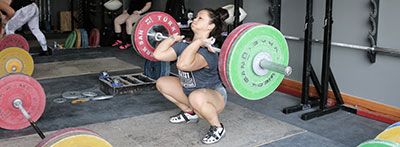
Since you're into OL, you should be doing full squats (calves touching ankles). The knees coming forward is a non-issue with the full squat. Let them go forward as much as they want to and more if you have ankle flexibility issues.
|
|
|
12-10-2008, 05:39 AM
|
#13
|
|
Senior Member
Join Date: Apr 2008
Posts: 692
|
I can't say that I've ever had any problems with my hip flexors while squatting but I've got osteoarthritis in both knees and I can do high bar squats without any problems, albeit with fairly light weights these days, whereas just thinking about low bar power-lifting squats is enough to have me reaching for the ice pack.
|
|
|
12-10-2008, 10:53 AM
|
#14
|
|
Senior Member
Join Date: Nov 2008
Posts: 338
|
Quote:
Originally Posted by Brian DeGennaro
In order to achieve the appropriate position in a high-bar squat your knees are going to be well ahead of the toes, as far as ankle flexibility permits.
|
Brian, I've been doing my work sets of 5 reps with 335lbs. Trust me, with that much weight, I know whether or not the weight is over my balance point or not (i.e. directly above the balls of my feet). I think I am getting the proper amount of knees traveling forward.
Quote:
Originally Posted by Donald Lee
I know you've had problems with your squatting from your post a few weeks ago on the CrossFit forum. Your knees not coming forward is probably where most of your problems lie. I used to squat like you did until I injured my back and learned otherwise (i.e., high bar squat with hips back).
|
Donald, I fixed that problem as soon as I realized I wasn't doing SS style squats. I was trying to do an SS style squat with the forward torso lean while using the high bar Olympic rack position. This was causing the weight to get too far forward of my balance point and resulting in me almost having to "good morning" the weight up. As soon as I realized this, I went back to the way I had formerly been doing squats with a more upright torso.
Maybe I am still in denial.
|
|
|
12-10-2008, 12:26 PM
|
#15
|
|
Member
Join Date: Jul 2008
Location: Nevada
Posts: 94
|
I did a post about this on the CF forums but it kind of got overlooked I think... Either way I guess I will cross-post it here as I feel it is very relevant to the question at hand. Not sure if that is bad form or anything, I apologize if it is
Quote:
You know Brian I was just thinking about the whole hip flexor soreness thing and may have a hypothesis.
Why is it that hip flexor tendinitis is so common when the knees are sliding forward at the bottom of the squat [Rip style]? Because the knees sliding forwards removes a large part of the hamstring contribution to the lift and the hip flexors end up doing the work that the much larger and stronger hamstrings should have done.
Now let us look at your high bar squat. In a high bar squat the back angle is much more vertical. This in effect shortens the proximal end hamstring removing in large part the stretch reflex that a low bar squat utilizes. SOOO the high bar squat has much less hamstring involvement, and thus the quads and hip flexors have to pick up more of the slack. This could lead to tendinitis and excess soreness even without the knees sliding forwards.....
|
What do you guys think?
__________________
"I swear by my life and by my love of it that I will never live for the sake of another man, nor ask another man to live for mine"
|
|
|
12-10-2008, 12:50 PM
|
#16
|
|
Senior Member
Join Date: Nov 2008
Posts: 338
|
Quote:
Originally Posted by Robert Callahan
I did a post about this on the CF forums but it kind of got overlooked I think... Either way I guess I will cross-post it here as I feel it is very relevant to the question at hand. Not sure if that is bad form or anything, I apologize if it is
What do you guys think?
|
Thanks Robert, That PM you sent me, which you quoted above, was what prompted me to start a post over here to get the O'Lifters perspective.
|
|
|
12-10-2008, 01:11 PM
|
#17
|
|
Senior Member
Join Date: Mar 2008
Posts: 646
|
This is my take.
The full squat requires much more hamstring flexibility than the low bar squat because you're squatting so much lower.
Now what are the hip flexors responsible for in the squat? As Steven said, the hip flexors help to create an anterior pelvic tilt. If you don't engage your hip flexors, it's much easier for your lower back to round, which means the posterior pelvic tilt or butt wink.
Because with the full squat it is so much harder to not round your back, to counteract the pull of your glutes and hamstrings, your hip flexors and abs have to fire that much more.
Hamstrings + Glutes --> posterior tilt & butt wink
Hip Flexors + Abs --> anterior tilt
|
|
|
12-10-2008, 02:03 PM
|
#18
|
|
Senior Member
Join Date: Nov 2008
Posts: 338
|
Quote:
Originally Posted by Donald Lee
This is my take.
The full squat requires much more hamstring flexibility than the low bar squat because you're squatting so much lower...Now what are the hip flexors responsible for in the squat? As Steven said, the hip flexors help to create an anterior pelvic tilt...Hip Flexors + Abs --> anterior tilt
|
Donald, If I understand correctly, I think you are basically saying my hip flexors are doing what they are supposed to be doing and I can expect them to be sore. So maybe it's all a mute point and actually an indicator that I am using proper form...
|
|
|
12-10-2008, 02:04 PM
|
#19
|
|
Senior Member
Join Date: Nov 2008
Location: Baldwin, NY
Posts: 513
|
Yup, he's right on that one. The hip flexors do include the rectus femoris as well, so obviously that is going to be working to help extend the knee. You are loading your hip flexors eccentrically with a lot more weight through a lot more ROM than they are used to, obviously they're going to cry out for some mercy.
|
|
|
12-10-2008, 02:10 PM
|
#20
|
|
Member
Join Date: Jul 2008
Location: Nevada
Posts: 94
|
Quote:
Originally Posted by Donald Lee
The full squat requires much more hamstring flexibility than the low bar squat because you're squatting so much lower.
|
The reason people typically get lower (though not always) in a high bar back squat is not because they have more flexible hamstrings, but rather because as I said above the hamstring is shortened by the anatomy of the movement. By shortening the hamstring you remove some of the tension and make it easier to get low without losing your pelvic tilt. This shortening also means that the hamstrings can no longer contribute as strong of a contraction though. So in order to get enough force production to get out of the whole the quads and hip flexors must work much harder.
If anything low bar back squats take much more hamstring flexibility to preform because of the extra tension put on the hamstrings when at full depth.
__________________
"I swear by my life and by my love of it that I will never live for the sake of another man, nor ask another man to live for mine"
|
|
|
| Thread Tools |
|
|
| Display Modes |
Linear Mode
|
Posting Rules
|
You may not post new threads
You may not post replies
You may not post attachments
You may not edit your posts
HTML code is Off
|
|
|
|
All times are GMT -7. The time now is 04:35 AM.
|
|
Submit your question to be answered by Greg or Aimee Everett in the Performance Menu or on the website
Submit Your Question
|
Catalyst Athletics is a USA Weightlifting team of competitive Olympic-style weightlifters. We are currently recruting new lifters and offer sponsorship opportunities.
Read More
|
|
|
|
|
|
|
All content © Catalyst Athletics, Inc. | 1257 Tasman Drive Suite A | Sunnyvale, CA 94089 | 408-400-0067 | Site Terms & Conditions
|
|
|

|