

Breathing and Breath Control for Olympic Weightlifting Greg Everett | Training: General | April 1 2008
Send to Kindle
Breath control is critical for increasing and maintaining the structural integrity of the torso while under heavy loads. The supporting musculature is alone inadequate—in order to adequately stabilize the spine, the abdominal and thoracic cavities must be pressurized. Additionally, we need to create as broad of a base for the torso as possible—the rationale for this should be obvious if one considers the structural integrity of a pyramid versus an upside-down pyramid. Drawing in the abs may look nice on the beach, but it will dramatically diminish the ability of the body to support the kind of forces we intend to introduce.
The torso has only a single supporting structure along its height—the spine—on one side, and this structure articulates in all directions, requiring additional support to maintain rigidity. The weak point is the circumference below the ribcage in which there is no rigid structure tying the torso into the pelvis—this creates a compressible area into which the torso can collapse forward and to the sides.
This area is of course filled with organs, the tissues of which are relatively incompressible, but the space inside of which we cannot directly make more resistant to compression. Above this, separated by the diaphragm, are the lungs. This provides us a convenient way to reduce the compressibility of the contents of the torso. By filling the lungs, we increase the rigidity of the thoracic cavity, and we also force the diaphragm down, which compresses the organs of the abdominal cavity somewhat.
To improve further on this compression, we can tighten the musculature surrounding the torso, which prevents unwanted expansion of the container walls and the resulting reduction of the potential for the torso to collapse.
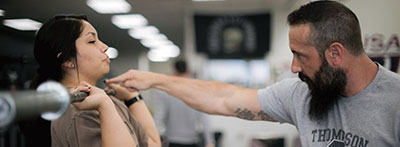
The athlete will need to draw in as much air as possible, allowing the abdomen to expand and the diaphragm to contract, ensuring the lungs are able to fill completely; filling the lungs partially by only allowing the chest to lift and expand is not adequate. Once this breath is taken, the lifter will tighten down the abdominal and back musculature to increase the internal pressure and reduce the potential for flexion or extension of the torso. This effort to tighten down around the pressurized torso will push air out of the lungs and up the trachea—the athlete will need to close the glottis in order to keep the air in (this should happen naturally with the effort to hold the breath).
It’s important that the athlete not “hollow”, or draw in the abdominals as many have been taught to do or believe is correct. If the abdominals are drawn in, the base of support is reduced in width, and this is obviously not beneficial. We want the muscles activated tightly while keeping the torso as wide and deep as possible, allowing us a broad foundation to support the load. It may help athletes having difficultly with this activation to think of pushing the abs down. (This does not mean that the transversus abdominis is not active; it simply means that it should not be the sole focus of the stabilization effort and should not be cinched in to a degree that limits the ability to fill the trunk adequately with air.)
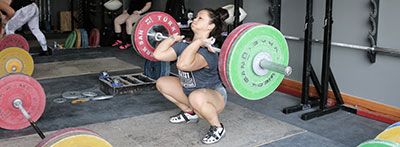
Pressurization should be maintained throughout as much of the movement as possible. There will be times, however, such as during the recovery of a clean, that the lifter will feel dizzy and even near unconsciousness. This can be because the athlete is not properly racking the barbell and the pressure is compressing the carotid arteries and reducing blood flow to the brain (this will be addressed in later chapters), but it can also be from actually holding the breath and bearing down simultaneously; these actions, especially when combined, stimulate the vagus nerve and reduce heart rate and blood pressure (this can be easily demonstrated by feeling your pulse while breathing normally, then holding your breath—you will feel an almost immediate reduction in heart rate). In some cases, this can cause unconsciousness, but this can be avoided by paying attention and reacting appropriately.
If dizziness or light-headedness occurs during lifts, the athlete should release a small amount of air during the highest-pressure moment of the lift by making some noise. This will release some air and reduce dizziness while maintaining trunk stability. Some athletes will be more comfortable, and even feel stronger, making a habit of always releasing air with noise during the recovery of the squat, as long as the release is controlled and minimal. If dizziness is considerable, it is always advised that the athlete drop the bar immediately and sit down safely to recover.
During the explosive second pulls of the snatch and clean, and even sometimes during the drive of the jerk, some lifters will make noise with an expulsion of a small amount of air. This is not problematic and is usually helpful in increasing the athlete’s aggressiveness.
The effect of torso pressurization can be demonstrated easily with a new lifter with nothing more than un-weighted squats. The athlete can pressurize the torso properly and perform a few squats, utilizing the bounce to recover. Following this, the athlete will expel as much air as possible, and squat again with the bounce. Invariably the difference is dramatic enough to immediately elicit some kind of exclamation from the athlete.
check valve... err i think you mean a relief valve, a check valve allows flow only in one direction, a relief valve protects a system from overpressurization
Greg Everett
2 | 2008-04-05
Right you are Ken.
Mark
3 | 2008-04-22
using your air filled lungs, while attempting a power movement, does not increase rigidity of the torso.
In fact the act of holding your breathe while attempting exertitive exercise, induces the valsava manuever, causing a drop in blood pressure and decrease in oxygen profussion to your muscles. Thus the light headedness.
Exhalation when exerting, causes contraction of the torso muscles, and extension of the spine, resulting in the muscular stability you desire.
peter
4 | 2008-08-20
I have been trying to do the deep breaths and have noticed a difference; but do you hold the one deep breath during all the reps you have to do, such as squat- 3 rounds 8 reps each exhaling slowly, or do you take one after each rep. after i get the bar on my back i can't take as deep a breath as i did before taking the bar off the rack.
Greg Everett
5 | 2008-08-20
Peter -
Take another breath (or a few) between each rep.
Fitz
6 | 2008-08-21
What is yall's take on "power breathing". This involves forcefully expelling your breath once you hit the "stick point" This helps you power through the lift. Then suck in air just before beginning the next rep.
Greg Everett
7 | 2008-08-21
Fitz -
See second to last paragraph.
Leave a Comment
Sign up for our free newsletter to get training tips and stay up to date on Catalyst Athletics AND get a free issue of the Performance Menu journal.
Catalyst Athletics is a USA Weightlifting team of competitive Olympic-style weightlifters. We are currently recruting new lifters and offer sponsorship opportunities.