



Articles
Correcting Jerk Weaknesses
March 11, 2011
March 11, 2011
Gerasimos Asks: Hello i want to ask a question about jerk training. When a lifter has a weak jerk (strength or technique) is better to perform jerk and assistance exercises in front or behind the head?
There are a huge number of possible causes for problems with the jerk. Since this question explicitly asks about both strength and technique, yet doesn't describe any specific issue, I'll try to cover both topics in a general sense without being so vague it's useless. Eventually I'll try to remember to actually answer the question about lifting from the front or back.
With regard to strength, we might consider it in four different areas: leg strength to achieve the upward acceleration of the bar; leg strength to support the weight in the receiving position and recover; upper body strength to support the weight in the receiving position; and upper body strength to drive the athlete under the bar (and drive the bar up slightly as well).
Leg strength for the upward drive of the bar will essentially be a product of squatting strength, more specifically the front squat as the drive of the jerk is primarily achieved by the quads. If general squatting strength is good, but the drive of the jerk appears weak, it can be addressed more specifically. Partial front squats, jerk dip squats, jerk drives, and jump squats can all be effective in this case. Consider trunk strength as well - softening of the trunk during the dip and drive of the jerk can absorb a significant amount of the upward force and render good leg strength ineffective.
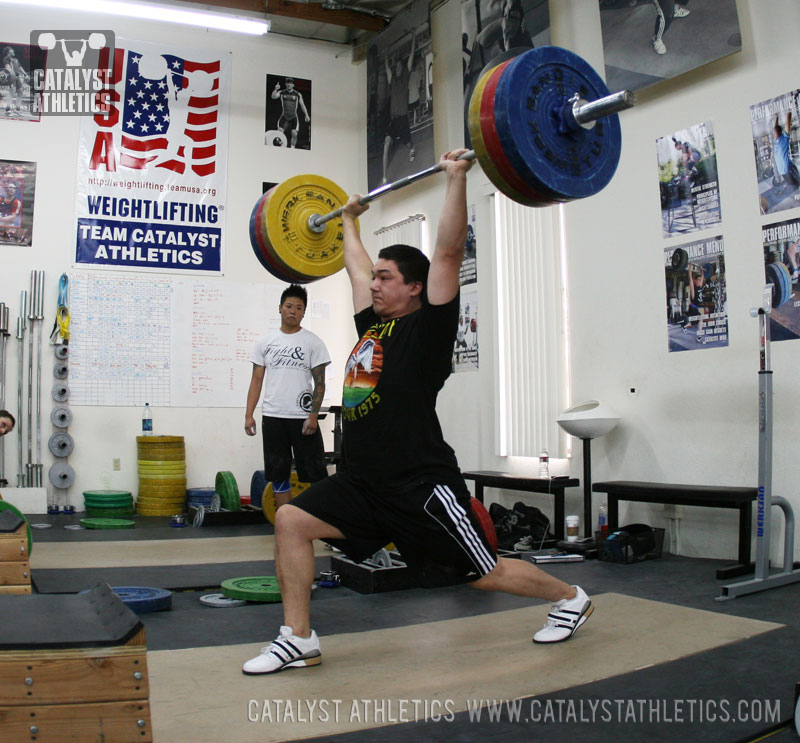
Inadequate length strength in the split receiving position can either mean an inability to support the weight that's been jerked, or it can actually prevent the lifter from getting into a sufficiently deep split position as weights increase. Again, squatting strength is the basis, but athletes can have surprising strength deficits in a split position. To address this, any number of single-leg squatting or lunging exercises can be used, but I do have some favorites. The basic lunge is the first simply because it's simple and easy to teach and there are many options for loading it safely. Next is an exercise I picked up from former Polish coach and current USA OTC resident coach Zygmunt Smalcerz. With a barbell on the back as it would be for a back squat, the lifter will step out into his split receiving position, making sure to maintain proper balance between the front and back feet, holds this momentarily, then steps forward into a split position with the other leg forward. Essentially this is a walking lunge, but rather than a typical deep lunge, the position is identical to the split jerk receiving position. This exercise can be done with very heavy weights - as much as 100% or more of the lifter's best jerk.
If the athlete's upper body is not strong enough to support the weight overhead, this can be address in a number of ways. Pressing exercises like the press and push press are the most basic; the push press is usually preferable because it allows the use of heavier weights as well as provides good practice of the dip and drive mechanics of the jerk. To overload the overhead position further, jerk supports and recoveries can also be used. For jerk supports, the lifter will place a barbell in a power rack on high pins, just a few inches below the height at which it would be with the athlete holding it overhead in a standing position. The athlete will bend at the knees and hips to get underneath the bar with the arms in a fully locked overhead position, then use the legs to lift the bar from the pins, holding the weight overhead for 3-5 seconds. Focus should be on locking in the elbows and shoulder blades forcefully. Jerk recoveries are similar, but the athlete will begin in the split position and lift the bar from the pins as he recovers from the split to a fully standing position.
Inadequate upper body drive strength is best addressed with the push press, which will also help timing for the jerk.
With regard to technique, there are too many possibilities to address directly. What needs to be done is a diagnosis of the source of the problem so it can be appropriately handled.
Exercises from behind the neck can be used if there are problems locating the correct overhead position, with driving the bar forward rather than up and back, or with failing to place the body under the bar properly to support it. The two most common related problems are 1) driving the bar forward and 2) pulling the hips back out from under the bar.
The first is an issue of the dip and drive phase of the lift, and can have a number of causes. The athlete may have his weight too far forward over the feet right from the start or may shift too far forward during the dip. If the weight is balanced during the dip and drive, the bar still may get pushed forward (and the lifter backward) due to an improper rack position or a change in the rack position during the dip or drive. Push presses, power jerks and split jerks from behind the neck can help the athlete feel what should be happening when lifting from the front with regard to body placement and balance.
The second problem is similar and has the same effect of placing the barbell in front of the base of support rather than balanced above it. In the split jerk, the hips must remain under the bar in the receiving position in order to support the weight. When jerking from the front, the torso position must change, and this can lead to unintended backward movement of the hips. The split jerk from behind the neck places the torso in exactly the position it will need to be in the split - the bar needs only to move straight up and the torso and hips need only to move straight down. Again, this drill can help the athlete feel what should be happening.
There are a huge number of possible causes for problems with the jerk. Since this question explicitly asks about both strength and technique, yet doesn't describe any specific issue, I'll try to cover both topics in a general sense without being so vague it's useless. Eventually I'll try to remember to actually answer the question about lifting from the front or back.
With regard to strength, we might consider it in four different areas: leg strength to achieve the upward acceleration of the bar; leg strength to support the weight in the receiving position and recover; upper body strength to support the weight in the receiving position; and upper body strength to drive the athlete under the bar (and drive the bar up slightly as well).
Leg strength for the upward drive of the bar will essentially be a product of squatting strength, more specifically the front squat as the drive of the jerk is primarily achieved by the quads. If general squatting strength is good, but the drive of the jerk appears weak, it can be addressed more specifically. Partial front squats, jerk dip squats, jerk drives, and jump squats can all be effective in this case. Consider trunk strength as well - softening of the trunk during the dip and drive of the jerk can absorb a significant amount of the upward force and render good leg strength ineffective.
Inadequate length strength in the split receiving position can either mean an inability to support the weight that's been jerked, or it can actually prevent the lifter from getting into a sufficiently deep split position as weights increase. Again, squatting strength is the basis, but athletes can have surprising strength deficits in a split position. To address this, any number of single-leg squatting or lunging exercises can be used, but I do have some favorites. The basic lunge is the first simply because it's simple and easy to teach and there are many options for loading it safely. Next is an exercise I picked up from former Polish coach and current USA OTC resident coach Zygmunt Smalcerz. With a barbell on the back as it would be for a back squat, the lifter will step out into his split receiving position, making sure to maintain proper balance between the front and back feet, holds this momentarily, then steps forward into a split position with the other leg forward. Essentially this is a walking lunge, but rather than a typical deep lunge, the position is identical to the split jerk receiving position. This exercise can be done with very heavy weights - as much as 100% or more of the lifter's best jerk.
If the athlete's upper body is not strong enough to support the weight overhead, this can be address in a number of ways. Pressing exercises like the press and push press are the most basic; the push press is usually preferable because it allows the use of heavier weights as well as provides good practice of the dip and drive mechanics of the jerk. To overload the overhead position further, jerk supports and recoveries can also be used. For jerk supports, the lifter will place a barbell in a power rack on high pins, just a few inches below the height at which it would be with the athlete holding it overhead in a standing position. The athlete will bend at the knees and hips to get underneath the bar with the arms in a fully locked overhead position, then use the legs to lift the bar from the pins, holding the weight overhead for 3-5 seconds. Focus should be on locking in the elbows and shoulder blades forcefully. Jerk recoveries are similar, but the athlete will begin in the split position and lift the bar from the pins as he recovers from the split to a fully standing position.
Inadequate upper body drive strength is best addressed with the push press, which will also help timing for the jerk.
With regard to technique, there are too many possibilities to address directly. What needs to be done is a diagnosis of the source of the problem so it can be appropriately handled.
Exercises from behind the neck can be used if there are problems locating the correct overhead position, with driving the bar forward rather than up and back, or with failing to place the body under the bar properly to support it. The two most common related problems are 1) driving the bar forward and 2) pulling the hips back out from under the bar.
The first is an issue of the dip and drive phase of the lift, and can have a number of causes. The athlete may have his weight too far forward over the feet right from the start or may shift too far forward during the dip. If the weight is balanced during the dip and drive, the bar still may get pushed forward (and the lifter backward) due to an improper rack position or a change in the rack position during the dip or drive. Push presses, power jerks and split jerks from behind the neck can help the athlete feel what should be happening when lifting from the front with regard to body placement and balance.
The second problem is similar and has the same effect of placing the barbell in front of the base of support rather than balanced above it. In the split jerk, the hips must remain under the bar in the receiving position in order to support the weight. When jerking from the front, the torso position must change, and this can lead to unintended backward movement of the hips. The split jerk from behind the neck places the torso in exactly the position it will need to be in the split - the bar needs only to move straight up and the torso and hips need only to move straight down. Again, this drill can help the athlete feel what should be happening.