



Articles
Olympic Weightlifting Skill Levels Chart
February 26, 2014
February 26, 2014
Update April 10 2025: Weight classes are changing again as of June 1 2025. Some day I may get around to updating these figures but don't hold your breath... by the time I have time, they'll probably changed again with the way things have been going the last few quads. Use these to estimate.
Update August 14 2018: Levels 3-5 have been adjusted to reflect more recent US competition performance and qualifying totals. This primarily affected levels 3-4, and most changes were minor.
Update July 9 2018: The IWF has released the new weight classes, none of which are repeats of any of the previous classes. Because these skill level figures were all based on 3-year averages of actual national and international competition numbers, obviously at this point figures for these new classes can’t be calculated the same way. Instead, I have extrapolated from the old classes and made some manual adjustments to account for certain anomalies. This preserves the natural variation among weight classes in terms of ability relative to bodyweight and is as accurate as such figures can be without any actual competition data to use.
Update July 5 2018: The IWF has released the new weight classes. I will be updating this chart as soon as possible. In the mean time, you're going to have to do some estimation or calculation. Note that the below listed classes are for all IWF competitions. The Olympic weight classes will reduce to 7 per gender (omitting 55, 89, 102 for men and 45, 71 and 81 for women).
Women:
45-49-55-59-64-71-76-81-87-87+
Men:
55-61-67-73-81-89-96-102-109-109+
Update April 28 2018: New weight classes are being introduced in July of this year. Because these figures are based on actual competition data, I won't be able to update this chart until these classes have competed for at least a year (the original chart is based on 3 years of competition), so please be patient.
Update March 23 2017: The new 90kg class is not yet included because there is not enough competition data. Once there is, the chart will be updated. 90+ will remain the same as 75+.
Update April 2015: The chart has been updated with the most recent competition results, a new level has been added, and the calculations for some of the figures have been changed. Most importantly, relativity to bodyweight is more accurate, i.e. the abillity of lighter classes to lift more than the heavier classes relative to bodyweight is better reflected in the figures.
I've finally gotten around to posting this a few years after I created it. For years people have been asking me if something like this existed and/or if I would make it. There is a Soviet classification system you can find in Weightlifting Programming: A Winning Coach's Guide and other places, but I've always thought it would be more appropriate to create a classification system based on actual American weightlifting performance and taking into account the particular circumstances of the sport in the US, including the fact that the vast majority of people interested in this kind of chart are starting the sport as adults.
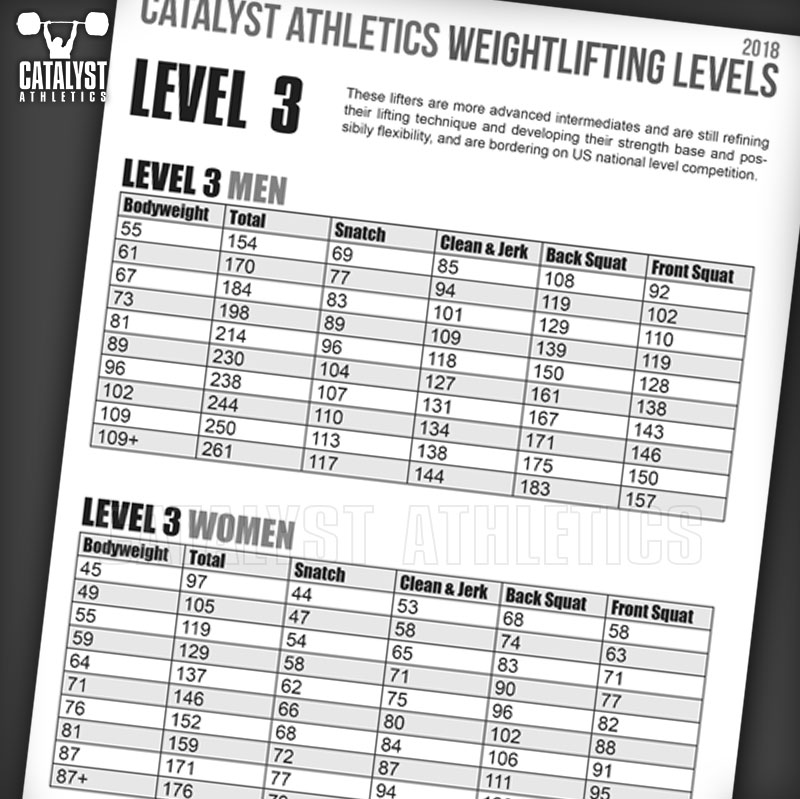
Along with snatch and clean & jerk figures, I've also included front squat, back squat and total. Keep in mind when looking at this chart that the relationships between the snatch, clean & jerk and squats are not identical for all athletes, and that being somewhat outside these numbers is not necessarily indicative of a problem. Use this chart as a way to help yourself set goals for your lifting more than as a diagnostic tool for lift relationships.
Download Chart (2018)
Download Chart (2015 - old classes)
Update August 14 2018: Levels 3-5 have been adjusted to reflect more recent US competition performance and qualifying totals. This primarily affected levels 3-4, and most changes were minor.
Update July 9 2018: The IWF has released the new weight classes, none of which are repeats of any of the previous classes. Because these skill level figures were all based on 3-year averages of actual national and international competition numbers, obviously at this point figures for these new classes can’t be calculated the same way. Instead, I have extrapolated from the old classes and made some manual adjustments to account for certain anomalies. This preserves the natural variation among weight classes in terms of ability relative to bodyweight and is as accurate as such figures can be without any actual competition data to use.
Update July 5 2018: The IWF has released the new weight classes. I will be updating this chart as soon as possible. In the mean time, you're going to have to do some estimation or calculation. Note that the below listed classes are for all IWF competitions. The Olympic weight classes will reduce to 7 per gender (omitting 55, 89, 102 for men and 45, 71 and 81 for women).
Women:
45-49-55-59-64-71-76-81-87-87+
Men:
55-61-67-73-81-89-96-102-109-109+
Update April 28 2018: New weight classes are being introduced in July of this year. Because these figures are based on actual competition data, I won't be able to update this chart until these classes have competed for at least a year (the original chart is based on 3 years of competition), so please be patient.
Update March 23 2017: The new 90kg class is not yet included because there is not enough competition data. Once there is, the chart will be updated. 90+ will remain the same as 75+.
Update April 2015: The chart has been updated with the most recent competition results, a new level has been added, and the calculations for some of the figures have been changed. Most importantly, relativity to bodyweight is more accurate, i.e. the abillity of lighter classes to lift more than the heavier classes relative to bodyweight is better reflected in the figures.
I've finally gotten around to posting this a few years after I created it. For years people have been asking me if something like this existed and/or if I would make it. There is a Soviet classification system you can find in Weightlifting Programming: A Winning Coach's Guide and other places, but I've always thought it would be more appropriate to create a classification system based on actual American weightlifting performance and taking into account the particular circumstances of the sport in the US, including the fact that the vast majority of people interested in this kind of chart are starting the sport as adults.
Along with snatch and clean & jerk figures, I've also included front squat, back squat and total. Keep in mind when looking at this chart that the relationships between the snatch, clean & jerk and squats are not identical for all athletes, and that being somewhat outside these numbers is not necessarily indicative of a problem. Use this chart as a way to help yourself set goals for your lifting more than as a diagnostic tool for lift relationships.
Download Chart (2018)
Download Chart (2015 - old classes)